
warm season · Cucurbitaceae
Growing Melon in Utah
Stop watering a week before harvest to concentrate the sugars.
Schedule (May 15 last frost)
When to do what
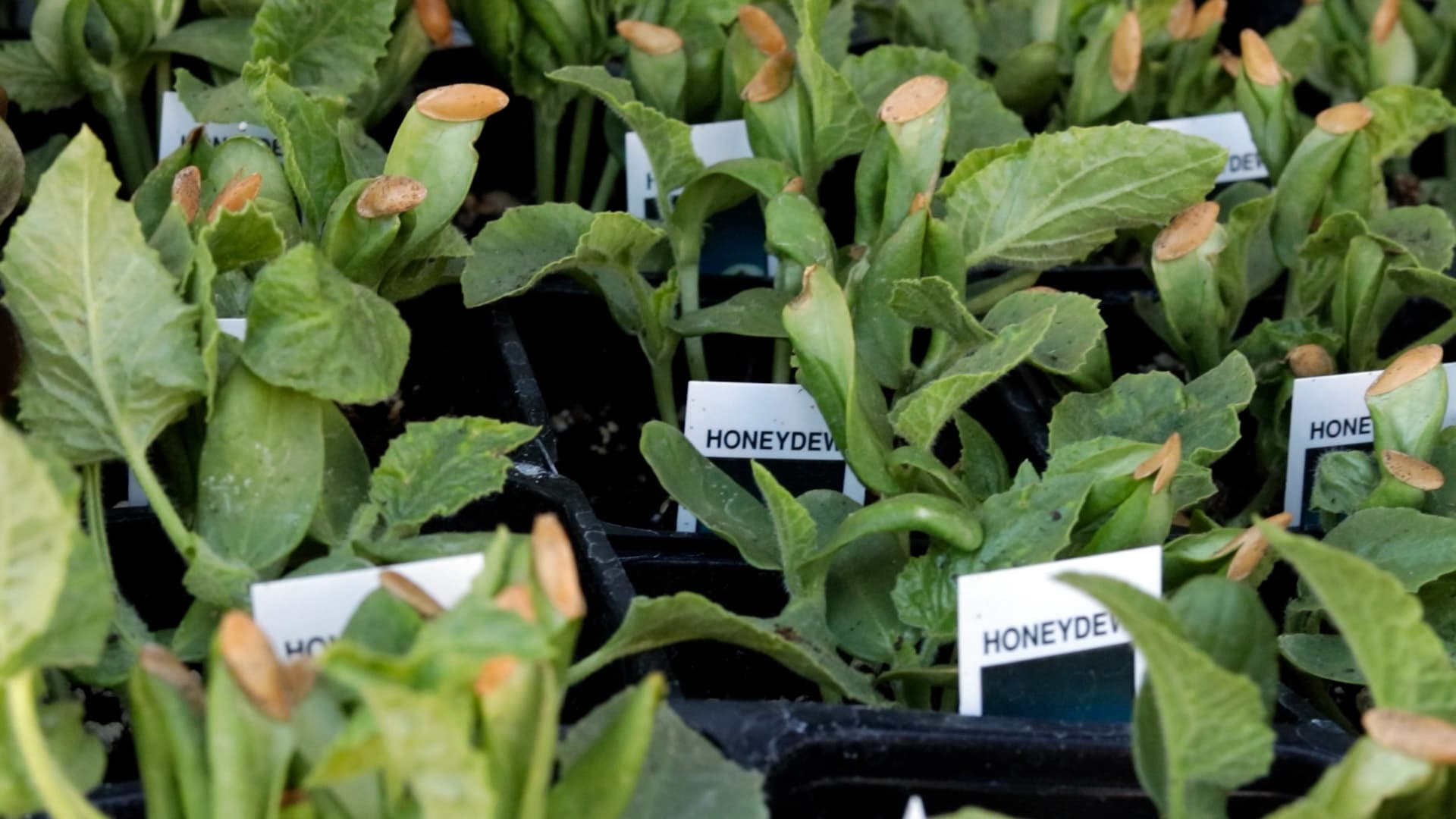
Start indoors
4/24
Transplant out
5/29
Direct sow
5/29
First harvest
8/14
Dates are calibrated for SUS Farms (Sevier County, Zone 6a, last frost May 15). For your own date, use the interactive calendar.
Planting
How deep, how far apart
Method
Indoor or direct
Seed depth
1″
Plant spacing
24″
Row spacing
60″
Germination temp
75–95°F
Days to maturity
80 days
How we grow it
Step-by-step
- 1.
Start indoors 3 weeks before last frost
Seed-starting mix in 2" or 4" cells. Bottom heat at 75–95°F until germination, then drop to room temperature. Light from a clip lamp 14–16 hours a day, 2" from the leaves.
- 2.
Harden off for 7 days before going outside
Day 1: 1 hour outside in shade. Add an hour and more sun each day. Skip the day if it’s windy or below 50°F. After day 7 the plants stay outside.
- 3.
Transplant 24″ apart in rows 60″ apart
Soil should be at least 75°F before transplanting — black plastic mulch laid down two weeks ahead helps in our cool springs. Water in deeply.
- 4.
Mulch and water consistently
2" of straw or wood chip mulch around the base. Drip line at the surface. Aim for 1" per week — including rain — measured at soil level, not by the calendar.
- 5.
Harvest around day 80
Days-to-maturity is a rough guide — taste, color, and size are the real signals. Stop watering a week before harvest to concentrate the sugars.
From the farm
What we’ve learned growing melon
Melon on a working farm means commitment -- most fruiting plants take 2-3 years before they start paying back, and they want consistent care across that time. The reward is decades of yield from the right site selection and the right variety. We pick varieties that handle Utah's late frosts and short summers; most of the trendy ones from East Coast catalogs don't make it here.
Pests & problems
Cucurbitaceae family pressures in Utah
Melon shares its troubles with cucumbers, melons, squash, pumpkins. The pests and diseases below show up most years; the fixes are what we actually do, not what catalogs sell.
Scout weekly during the growing season — most outbreaks are 10x easier to manage when you catch them in week one.
Pest 1
Cucumber beetle -- striped or spotted yellow beetles. Vector for bacterial wilt that can collapse a plant in days. Floating row cover until first flower; remove for pollination.
Pest 2
Squash bug -- bronze egg masses on leaf undersides. Hand-pick eggs every other day; trap adults under boards laid on the soil.
Pest 3
Squash vine borer (lower elevations only) -- wilted vine with sawdust at the base. Slit the stem, remove the larva, bury the wound in soil so it re-roots.
Disease 1
Powdery mildew -- white powder on leaves in late summer. Plant resistant varieties; thin for airflow; potassium bicarbonate spray slows progression.
Disease 2
Bacterial wilt -- vines collapse mid-season after looking fine. Almost always tracks back to a cucumber-beetle hit earlier. No cure; pull and trash (not compost) infected plants.
Companion planting
What to plant near (and away from) melon
Most companion-planting charts you see online are folklore. The pairings below have either USU Extension research, Cornell vegetable MD pages, or our own multi-year farm logs behind them.
Plant near
Good companions
- ✓Corn (Three Sisters partner -- vertical support and partial shade)
- ✓Beans (Three Sisters partner -- fixes nitrogen)
- ✓Nasturtium (trap crop for cucumber beetle)
- ✓Radish (interplant; deters beetles before harvest)
Plant away from
Bad companions
- ✗Potatoes (compete for nutrients, share fungal diseases)
- ✗Aromatic herbs near melons (some research suggests reduced sweetness)
Crop rotation
Cucurbits should not return to the same bed for 3+ years. Heavy feeders -- best after a legume cover crop or fresh compost top-dress.
Harvest & storage
Picking, keeping, preserving
When to pick
Days-to-maturity (80 days from transplant) is a baseline. The real signals are color, size, and feel. Stop watering a week before harvest to concentrate the sugars.
How to harvest
Clean cuts with sharp pruners or scissors heal faster than ripped stems and reduce disease entry points. Harvest early morning when sugars are highest and the plant is fully turgid; afternoon-harvested produce wilts faster. Don't harvest when leaves are wet -- fungal spores ride along.
Short-term storage
Most warm-season produce stores best at 50-55°F (NOT in the fridge -- chilling injury reduces quality and flavor). Tomatoes especially: refrigeration kills flavor; counter-store at 55-65°F until ripe.
Long-term preservation
Freezing, canning, drying, and fermenting all preserve melon. Pick the method that matches your kitchen and how you actually use the harvest -- frozen tomatoes are great for sauce but bad for sandwiches; dried herbs work everywhere; fermented vegetables shine in salads.
Mistakes we’ve made
Common ways to fail at melon
Each of these has cost us a season at some point. Easier to learn from someone else’s lost crop than your own.
Planting too deep
The fix:Melon seeds want exactly 1" of cover -- about a knuckle deep -- the depth of your first finger joint. Deeper than that and the seedling exhausts itself before reaching light. Carrots and lettuce especially: shallow is right; sprinkle, then cover with a dusting of soil and tamp gently.
Skipping the harden-off step
The fix:Plants raised under indoor lights have soft cuticles and weak stems. Move them straight outside and they sunburn, snap in wind, or wilt and never recover. The 7-day gradual sun exposure is mandatory, not optional.
Watering on a calendar instead of by need
The fix:Stick a finger or screwdriver 4" into the bed. Damp at depth = wait. Dry at depth = water deeply. Calendar watering ignores rain, heat waves, and seasonal evapotranspiration -- leading to either drought stress or root rot.
Ignoring soil pH
The fix:Most Utah backyard soil tests at pH 7.4-8.4 (alkaline). Iron and zinc become unavailable to roots above pH 7.5 -- leaves yellow, growth stalls. A $20 mailer test from USU Extension tells you exactly what your soil needs. Sulfur amendment in fall, foliar iron mid-season as needed.
Planting too early
The fix:A warm-season crop set out before soil hits 60°F at 4" depth sits and sulks -- sometimes for weeks before either dying outright or refusing to grow until July. Wait. Better to plant a week late than plant 3 weeks early into cold soil.
Common questions
Frequently asked about melon
+When should I start melon indoors in Utah?
In Sevier County (last frost May 15), start 3 weeks before -- that's roughly April. If you're at higher elevation (Park City, Logan), add 2 weeks. Lower elevation (Salt Lake, St. George), subtract 2-4 weeks. Use the interactive seed-starting calendar at /seeds/calendar to dial it in for your specific frost date.
+Can I direct-seed melon in Utah?
Yes -- many growers do, especially in our short season. When direct sowing, wait until soil temperature hits 75°F (use a soil probe thermometer; air temp is misleading). Sow 1" deep, 24" apart. Black plastic mulch laid 2 weeks ahead of sowing warms the soil 8-10°F faster.
+Why are my melon leaves turning yellow?
Three usual suspects. (1) Iron chlorosis -- yellow leaves with green veins is the Utah classic; the cause is alkaline soil locking up iron. Foliar iron rescues the season; sulfur amendment in fall fixes it long-term. (2) Nitrogen deficiency -- entire leaf yellow including veins, starts with old leaves. Side-dress with compost or a slow-release organic fertilizer. (3) Overwatering -- yellowing accompanied by soft, mushy stems means the roots are drowning. Check drainage; reduce water frequency.
+Can I plant melon before the last frost date?
Not safely. Melon is a warm-season crop -- even a light frost (28-32°F) kills the plant or stunts it for the rest of the season. Wait until soil hits 75°F at 4" depth AND there are no freezing temperatures in the 14-day forecast. In Sevier County that's typically the third week of May. Black plastic mulch + floating row cover let you push planting 7-10 days earlier.
+How long does melon take from seed to harvest?
80 days from transplant. Add 21 days for the indoor seed-starting phase, so total time from sowing seed to first harvest is roughly 101 days. Days-to-maturity is a baseline -- cool springs add a week or two; hot summers can speed up by similar amounts. Use it for planning, not as a strict calendar.
+What's the spacing between melon plants?
24" between plants in the row, 60" between rows. That gives mature plants room to fill in without competing. Closer spacing reduces yield per plant; wider spacing wastes garden space. The numbers come from average mature plant size at full vegetative growth -- adjust slightly for compact varieties (closer) or large heirlooms (wider).
Same family (Cucurbitaceae)
Related crops
Sources:Johnny’s Selected Seeds·USU Extension·Cross-checked with our greenhouse logs.